





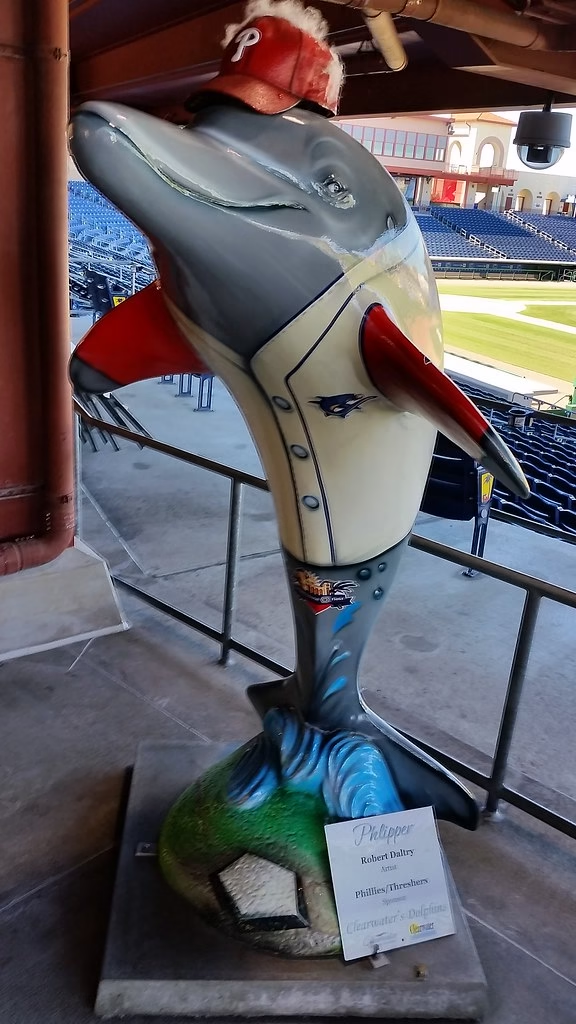
Major League Baseball (MLB) is currently observing a historic milestone as it reflects on 150 years of professional competition, tracing its formal origins back to April 22, 1876, when the Boston Red Stockings faced the Philadelphia Athletics. This sesquicentennial anniversary marks a century and a half of the sport evolving from a regional pastime into a global cultural and economic powerhouse. While the game on the field has undergone radical shifts in technology, strategy, and demographics, the structure established in the late 19th century remains the bedrock of American professional sports.
The Birth of the National League
In 1876, William Hulbert, a businessman from Chicago, spearheaded the formation of the National League (NL) to replace the unstable National Association. Hulbert sought to bring order, accountability, and profitability to the sport by establishing strict rules for contracts and scheduling. By requiring teams to play in cities with populations of at least 75,000, the league ensured a stable financial base that allowed baseball to survive the volatile economic climate of the post-Civil War era.
A Century of Transformation
The transition from the “Dead Ball Era” of the early 1900s to the modern era of high-velocity pitching and analytical optimization highlights the sport’s capacity for reinvention. Throughout the 20th century, integration in 1947 and the expansion of the league into new markets helped solidify baseball’s status as the “National Pastime.” The integration of data science in the early 2000s, famously popularized by the ‘Moneyball’ philosophy, fundamentally altered how front offices value players and manage in-game tactics.
Expert Perspectives on Longevity
Sports historians note that baseball’s endurance is largely tied to its unique pacing and statistical depth. According to data from the Society for American Baseball Research (SABR), the sport has maintained a consistent fan base through every major global conflict and economic recession of the last 150 years. Analysts point to the game’s inherent focus on individual duels within a team context as a primary driver of its sustained popularity.
Industry Implications and Future Outlook
For the modern industry, the 150th anniversary serves as a pivot point toward addressing shifting viewership habits among younger demographics. League officials are increasingly focused on pace-of-play initiatives, such as the implementation of the pitch clock, to ensure the game remains competitive in an era of shorter attention spans. As the sport moves into its next century, stakeholders are closely watching the intersection of digital broadcasting rights and legalized sports betting, both of which are expected to redefine the fan experience.
Looking ahead, the focus for MLB will remain on balancing its deep historical traditions with the need for technological innovation. Observers should monitor how the league navigates the potential expansion to 32 teams and the continued integration of artificial intelligence in player development programs. The next decade will likely be defined by how successfully the organization bridges the gap between its storied past and a rapidly digitizing future.