





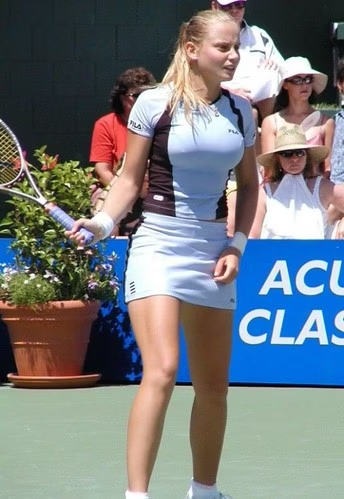
Ukrainian tennis player Oleksandra Oliynykova issued a forceful public statement this week, demanding that Russian athletes take a definitive stand against the ongoing invasion of their country. Speaking after a high-profile match against a Russian opponent, Oliynykova declared that she can no longer remain silent while the conflict continues to devastate her homeland.
The Context of Athletic Neutrality
Since the onset of the full-scale invasion in February 2022, the international sporting community has struggled to navigate the participation of Russian and Belarusian athletes. While many sporting bodies initially imposed blanket bans, the International Olympic Committee and various tennis governing bodies eventually transitioned to a policy of neutral participation.
This policy allows individuals to compete under a neutral flag, provided they do not actively support the war effort. However, critics argue that this framework fails to address the moral responsibility of high-profile athletes who command significant public influence.
Rising Tensions on the Court
Oliynykova’s recent remarks highlight a deepening rift within the professional tennis circuit. She emphasized that silence from Russian peers is often perceived by Ukrainians as a tacit acceptance of the aggression occurring on their soil.
During her post-match press conference, Oliynykova noted that the personal toll of the war is inescapable for Ukrainian players. She expressed frustration that the professional sphere continues to prioritize the comfort of neutral competition over the ethical imperative to denounce state-sponsored violence.
Expert Perspectives and Industry Data
Sports psychologists and industry analysts point out that the pressure on players from both nations is unprecedented. Dr. Elena Petrov, a consultant on international sports relations, suggests that the “neutral athlete” designation has created a vacuum of accountability.
“Athletes are global ambassadors, and when they remain silent on humanitarian crises, they inadvertently signal that their professional advancement is detached from global human rights standards,” Petrov stated. Data from the Women’s Tennis Association (WTA) indicates that while players are not officially required to make political statements, the internal friction has led to increased on-court tension and a noticeable decline in post-match interactions between players from the warring nations.
Implications for the Future of Global Sports
The stance taken by players like Oliynykova suggests a shifting landscape where silence is increasingly viewed as a political act. As the war persists, the pressure on governing bodies to refine their neutrality policies is mounting.
Observers should watch for potential policy revisions within the ATP and WTA that may mandate more explicit conduct codes regarding political expression. Furthermore, as the 2024 Olympic cycle approaches, the debate over whether “neutrality” is a viable long-term solution or merely a temporary stopgap will likely intensify, forcing both sponsors and international federations to reconsider their stance on athlete activism.


