



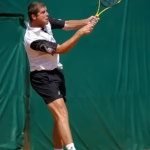






Three-time Grand Slam champion Stan Wawrinka exited the French Open in the first round on Tuesday, marking what is widely expected to be his final appearance at the clay-court major in Paris. The 39-year-old Swiss veteran, who famously defeated Novak Djokovic to claim the title in 2015, fell to his opponent in a hard-fought match that highlighted the physical toll of a storied two-decade career.
A Legacy Defined by Grit
Wawrinka’s departure from Roland-Garros represents the end of an era for tennis fans who grew up watching the “Big Four” era challenged by his explosive one-handed backhand. Throughout his career, Wawrinka occupied a unique space in professional tennis, often described as the player who could dismantle the sport’s greatest legends when operating at his peak.
His 2015 French Open victory remains one of the most significant upsets in modern tennis history. By overcoming Djokovic, then the world number one, Wawrinka cemented his reputation as a big-match player capable of immense power and tactical brilliance.
The Physical Evolution of the Game
The transition from the dominance of players like Wawrinka to the rising generation of athletes reflects a broader shift in professional tennis. Younger players now rely heavily on high-speed court coverage and extreme spin, contrasting with the heavy, baseline-pounding style that defined Wawrinka’s prime years.
Data from the Association of Tennis Professionals (ATP) indicates that the average age of top-ranked players has fluctuated, but the physical demands of the tour have increased significantly. The wear and tear on joints and muscles, particularly for players who have competed for over 15 years, has forced many legends to shorten their schedules or face early-round exits against fresher, faster competitors.
Expert Perspectives on the Transition
Tennis analysts note that Wawrinka’s ability to remain competitive at age 39 is an outlier in a sport that has become increasingly grueling. While his recent results have not mirrored his championship form, his presence on the court continues to draw significant attendance and viewership, underscoring his enduring popularity with global audiences.
“Stan represents a bridge between the old guard and the modern power game,” says tennis historian Marcus Thorne. “His exit signals that we are firmly in the next chapter of the sport, where the sheer physicality of the game is pushing even the most resilient veterans toward retirement.”
Looking Ahead
As Wawrinka departs the Parisian stage, the industry is left to consider the void left by his departure. The focus now shifts to the next generation of clay-court specialists who must fill the gap in star power and competitive intensity at Roland-Garros.
Observers will be watching closely to see if Wawrinka chooses to continue his career on faster surfaces or if this loss marks the beginning of a final retirement tour. Regardless of his next step, his impact on the French Open remains etched in the tournament’s history, serving as a benchmark for grit, determination, and the ability to defeat the odds on the world’s most demanding surface.


